
Medically reviewed by Dr. Ploy, MD, Qualified Peptide Therapy Doctor, Board Certified in Family Medicine, Regenerative & Longevity Medicine Specialist , licensed by the Medical Council of Thailand.
Last reviewed: September 2026
Short answer: It is not established that retatrutide causes anhedonia, which means a marked loss of interest or pleasure. Published retatrutide trials do not provide a reliable incidence, a proven dose relationship, or a confirmed brain mechanism for this symptom. However, new emotional flatness or loss of enjoyment should not be dismissed. It can reflect depression, another health problem, the effects of rapid weight loss or reduced intake, a medicine effect, or several factors together.
Retatrutide is still investigational and has not been approved by any regulatory agency. Anyone experiencing a significant mood or motivation change during a clinical trial or after using a product sold as retatrutide should contact a qualified clinician promptly. Do not rely on online dosing advice or change treatment without clinical guidance.
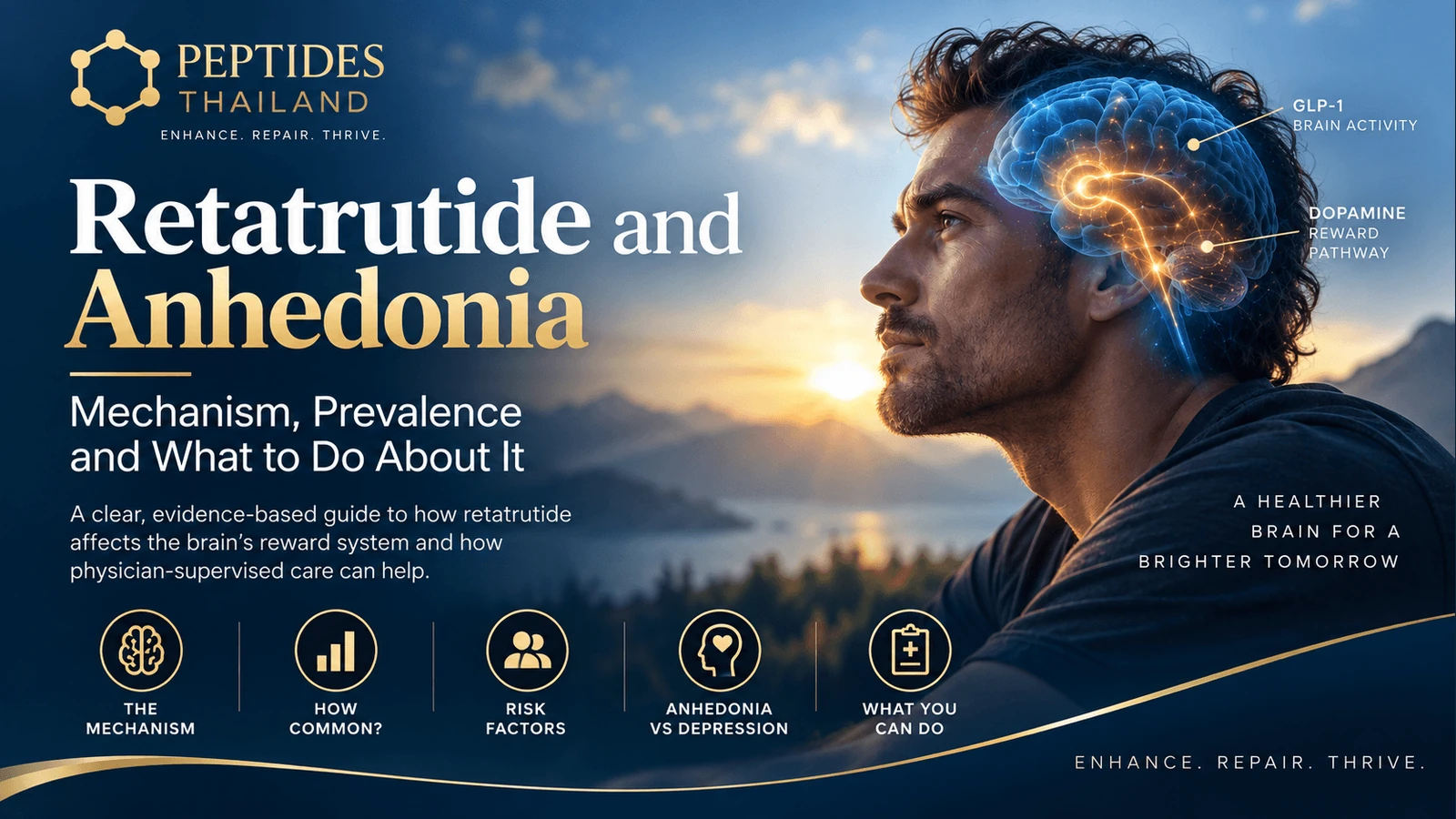
The hero brain graphic is a conceptual illustration. It does not show a proven retatrutide effect or confirmed human mechanism.
Key Takeaways
- Retatrutide trials have not established how often anhedonia occurs, whether retatrutide causes it, or whether risk changes at a particular dose.
- Animal GLP-1 research offers hypotheses about food reward, but it does not prove that retatrutide suppresses dopamine or general pleasure in humans.
- Anhedonia can be part of depression even without obvious sadness. It can also occur with other psychiatric, neurological, endocrine, nutritional, sleep-related, or medication-related problems.
- There is no evidence-based promise that symptoms will resolve after a fixed number of days or weeks.
- Persistent, worsening, or function-limiting symptoms need clinical assessment. Suicidal thoughts or an inability to stay safe need immediate help.
What Is Anhedonia?
Anhedonia is reduced interest in or pleasure from experiences that normally matter. It may affect:
- hobbies, music, exercise, or creative activities
- time with family or friends
- intimacy and close relationships
- enjoyment or anticipation of food
Anhedonia is more than having less interest in highly palatable food during weight loss treatment. It is concerning when it spreads across life, persists, or interferes with relationships, work, self-care, or safety.
The US National Institute of Mental Health identifies loss of interest or pleasure as a common symptom of depression. Depression can include low mood, hopelessness, fatigue, sleep or appetite changes, concentration problems, guilt, slowed or restless behavior, and thoughts of death or suicide. Not everyone has every symptom, and not everyone describes feeling sad. This is why “flat but not sad” is not enough to rule depression out.
Does the Human Retatrutide Evidence Show Anhedonia?
The best answer is that the evidence is currently insufficient.
In the published phase 2 obesity trial, 338 adults received retatrutide or placebo for 48 weeks. The most commonly reported adverse events were gastrointestinal, were dose-related, and were generally mild to moderate. The publication established neither an anhedonia rate nor a causal relationship between retatrutide and anhedonia.
The corresponding ClinicalTrials.gov record, NCT04881760, is useful for checking the study design, outcome reporting, and trial status. Neither that record nor the journal report supports a precise claim such as “a meaningful minority,” a threshold dose at which anhedonia begins, or a comparison ranking against semaglutide or tirzepatide.
This distinction matters: retatrutide’s three-receptor activity and the gastrointestinal adverse events reported in trials are documented. Anhedonia incidence, causality, dose-response relationships, and individual risk factors remain uncertain. Reports from individuals can identify a concern worth studying, but cannot establish its cause or frequency.
Trials may not capture every uncommon effect, especially when a symptom is not prespecified. That limitation calls for careful assessment, not an incidence estimate based on anecdotes.
For the broader safety context, see the retatrutide side effects guide. For an overview of its three-receptor pharmacology, see what retatrutide is and how it is being studied.
What About GLP-1, Dopamine, and Reward?
There is a biologically interesting hypothesis, but it is often overstated online.
Preclinical research shows that GLP-1 signaling can influence feeding and reward pathways. A 2014 rodent study found that GLP-1 receptor activation in the nucleus accumbens core suppressed feeding through glutamatergic signaling.
It does not establish that:
- retatrutide reaches a particular human brain region at a clinically relevant concentration
- retatrutide directly suppresses dopamine in people
- reduced food reward necessarily becomes reduced pleasure from music, relationships, or everyday life
- GLP-1 findings from rodents apply to a triple GLP-1/GIP/glucagon agonist in humans
Animal studies generate hypotheses but cannot prove why a human symptom occurred. Human retatrutide studies measuring mood, reward, and motivation are needed.
Other Causes Need to Be Considered
Timing can offer a clue, but a symptom beginning after a product does not prove the product caused it. A clinician may consider:
- depression, anxiety, grief, burnout, or another mental health condition
- sleep deprivation or a sleep disorder
- thyroid disease, anemia, infection, or another medical condition
- substances, withdrawal, other medicines, or interactions
- very low energy intake, dehydration, nausea, or rapid weight change
- uncertainty about the identity, strength, purity, or sterility of an unapproved product
A useful assessment considers timing, severity, duration, other symptoms, medicines and substances, recent weight change, and any thoughts of self-harm.
Risk Factors: What to Discuss With Your Clinician
Dose, nutrition, sleep, and mood are useful topics for a consultation. However, they are not established predictors of retatrutide-induced anhedonia. This table separates reasons for assessment from claims the evidence cannot yet support.
| Factor to discuss | Why it matters | Evidence limit |
|---|---|---|
| Higher dose | Record the dose and whether symptoms began after a change. | No specific dose threshold or dose-related anhedonia risk has been established. |
| Rapid dose escalation | The timing of treatment changes helps a clinician assess tolerability and possible causes. | Slower titration has not been proven to prevent anhedonia. |
| Very low calorie intake | Reduced intake, nausea, dehydration, and rapid weight change deserve assessment alongside low energy or mood changes. | A particular calorie target has not been shown to prevent or reverse this symptom. |
| Low protein intake or poor nutrition | Restricted eating can make it difficult to meet nutritional needs. | Protein targets or dopamine-precursor supplements are not established treatments for retatrutide-associated anhedonia. |
| Poor sleep | Sleep problems can accompany mood changes and affect daily functioning. | Improving sleep supports general health but is not a proven remedy for a retatrutide-specific effect. |
| Previous low mood or loss of interest | A mental health history helps a clinician assess depression, other causes, and current safety. | It does not establish that retatrutide caused the symptoms or predict an individual’s medication-related risk. |
Retatrutide Compared With Other GLP-1 Medicines
Semaglutide, tirzepatide, and retatrutide act on different combinations of receptors. That difference does not establish a ranking of anhedonia risk. Weight-loss results from separate trials cannot be used as a measure of dopamine suppression or psychiatric safety.
| Medicine | Receptor targets | Anhedonia comparison |
|---|---|---|
| Semaglutide | GLP-1 | No reliable head-to-head anhedonia risk ranking against tirzepatide or retatrutide is established. |
| Tirzepatide | GLP-1 and GIP | Dual-receptor activity does not establish a higher or lower anhedonia risk. |
| Retatrutide | GLP-1, GIP, and glucagon | Investigational. Anhedonia incidence and comparative risk remain unknown. |
For broader context, see the semaglutide, tirzepatide, and retatrutide comparison. New loss of pleasure warrants assessment regardless of which medicine or product someone has used.
What to Do If You Notice Emotional Flatness
- Record the change clearly. Note when it began, which activities feel different, other symptoms, and effects on daily function.
- Contact the treating clinician or trial team promptly. If a product came from outside a regulated trial, say exactly what was used and bring its packaging if available.
- Do not make dose changes by yourself. There is no validated self-treatment schedule for retatrutide-related anhedonia.
- Do not try to treat it with a rigid protein target or supplements. Adequate nutrition matters for general health, but no protein prescription, amino acid supplement, or specific calorie level has been proven to prevent or reverse this symptom.
- Ask for a broader assessment. This may include mental health and medication reviews, an examination, or targeted tests.
- Stay connected. Tell a trusted person what is happening, particularly if motivation is falling or symptoms are worsening.
There is also no evidence-based guarantee that slowing titration, holding a dose, reducing a dose, or stopping will resolve anhedonia within a particular timeline. Those may be decisions a qualified clinician considers, but the safest choice depends on the individual context.
Urgent Support
Get urgent help now if you have thoughts of suicide or self-harm, have made a plan, feel unable to keep yourself safe, or develop severe agitation, confusion, psychosis, or rapidly worsening symptoms.
Call local emergency services or go to the nearest emergency department. If possible, ask a trusted person to stay with you and remove access to anything you could use to harm yourself. In the United States, call or text 988. Elsewhere, use your local crisis line or emergency number.
The FDA’s January 2026 review found no increased risk of suicidal behavior or ideation with the approved GLP-1 medicines it evaluated. That is reassuring for those approved products, but it does not establish the psychiatric safety profile of investigational retatrutide and should never delay help for an individual with concerning symptoms.
Retatrutide Is Still Investigational
As of the publication date, Lilly describes retatrutide as an investigational triple hormone receptor agonist. It has not been approved by any regulatory agency and is available legitimately only to participants in Lilly-sponsored clinical trials. Products marketed online as retatrutide are not proof of an approved or verified medicine.
Medical supervision does not make an unapproved product approved, guarantee its contents, or eliminate risk. If you are considering weight management treatment in Thailand, the patient guide to retatrutide and approved alternatives explains the questions to bring to a consultation. A clinician can discuss regulated options and assess whether any treatment is appropriate.
Frequently Asked Questions
Does retatrutide cause anhedonia?
It is not established that retatrutide causes anhedonia. The published phase 2 obesity trial did not provide a standalone incidence for anhedonia, so the frequency and causality are unknown. New loss of pleasure or emotional flatness still deserves prompt clinical assessment.
How common is anhedonia with retatrutide?
No reliable percentage is available. Retatrutide trials have not established anhedonia incidence, and online reports cannot determine prevalence or prove that the medicine caused a symptom. There is also no proven dose-specific risk.
How can anhedonia feel?
Anhedonia can feel like reduced pleasure, interest, anticipation, or motivation. A person may stop enjoying music, social contact, hobbies, intimacy, or food. These experiences overlap with depression and other medical or psychological conditions, so symptoms should be assessed rather than self-diagnosed.
Can anhedonia occur without sadness?
Yes. Loss of interest or pleasure can be a central feature of depression even when sadness is not the person’s main complaint. The absence of obvious sadness does not exclude depression. A qualified clinician should assess the full pattern, duration, impairment, health history, and safety concerns.
Will symptoms go away after changing or stopping retatrutide?
There is not enough evidence to promise reversibility or a recovery timeline for retatrutide-associated anhedonia. Do not change an investigational or prescribed treatment on your own. Contact the treating clinician promptly so they can assess possible causes and decide on safe next steps.
When is loss of pleasure an emergency?
Seek urgent help now if emotional changes come with thoughts of suicide or self-harm, a plan or intent to act, inability to stay safe, severe agitation, psychosis, or rapidly worsening symptoms. Contact local emergency services or go to the nearest emergency department, and involve a trusted person if possible.
References
- Jastreboff AM, et al. Triple-Hormone-Receptor Agonist Retatrutide for Obesity: A Phase 2 Trial. New England Journal of Medicine. 2023.
- ClinicalTrials.gov. NCT04881760: A Study of LY3437943 in Participants Who Have Obesity or Are Overweight.
- Eli Lilly and Company. What to know about retatrutide: an investigational triple hormone receptor agonist. Updated July 2026.
- National Institute of Mental Health. Depression.
- Dossat AM, et al. Glucagon-like peptide-1 receptor activation in the nucleus accumbens core suppresses feeding by increasing glutamatergic AMPA/kainate signaling. Journal of Neuroscience. 2014.
- US Food and Drug Administration. FDA requests removal of suicidal behavior and ideation warning from GLP-1 receptor agonist medications. January 13, 2026.
If you want to discuss regulated weight management options or concerning symptoms, book a consultation with a licensed physician. This educational article cannot diagnose anhedonia, depression, or a medication adverse effect.