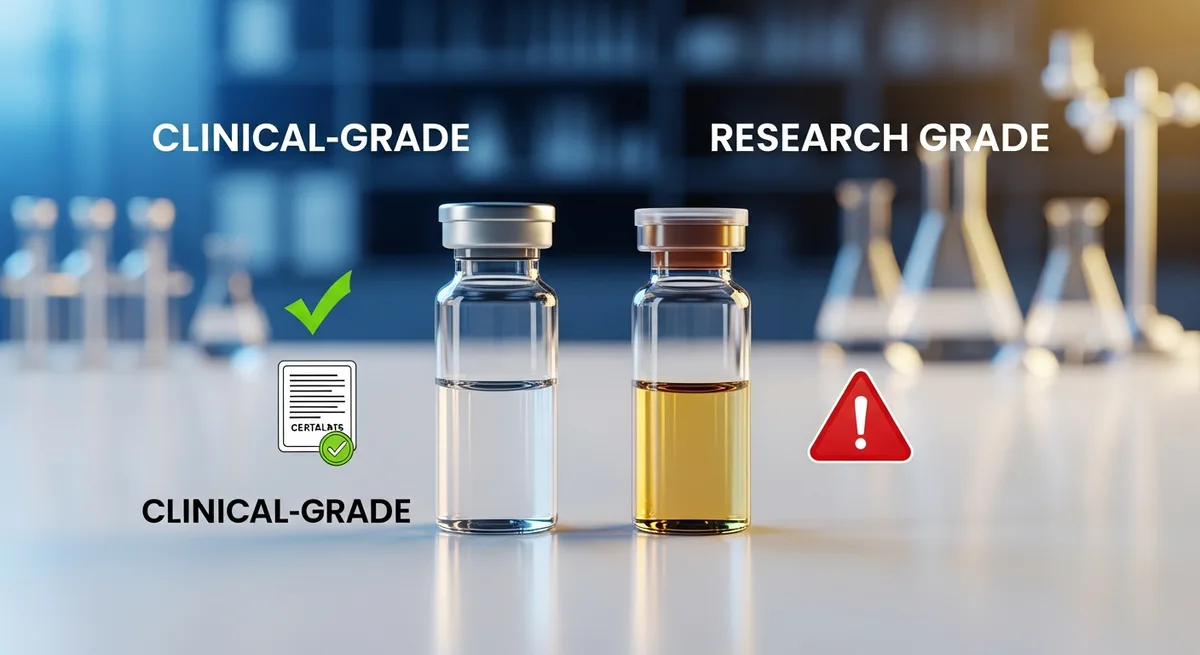
Most conversations about peptide therapy focus on which peptide to use, how to dose it, and what results to expect. Those are reasonable questions. But the question that should come first is one that most people skip entirely: What is actually in the vial?
The difference between clinical-grade and research-grade peptides is not a minor technicality. It is the single most important safety variable in the peptide market today, and it is the one that patients are least equipped to evaluate on their own.
At Peptides Thailand, this is the starting point. Not because sourcing is a marketing angle, but because no protocol can be safe or effective if the product itself is unreliable.
What “Research-Grade” Actually Means
Research-grade peptides are manufactured for use in laboratory experiments: cell cultures, animal studies, and in vitro testing. They are not produced for human therapeutic use.
This distinction matters because the manufacturing standards are fundamentally different:
- Sterility is not guaranteed. Research labs do not need injectable-grade sterility for a cell culture experiment. But a patient injecting subcutaneously does.
- Endotoxin testing may be absent or minimal. Endotoxins are bacterial byproducts that can cause fever, inflammatory reactions, and in severe cases, sepsis. Research-grade products may not test for these at the thresholds required for human safety.
- Purity may be lower than stated. A product labelled 95% purity may contain degradation products, synthesis byproducts, or residual solvents that would not pass pharmaceutical inspection.
- Labelling can be inaccurate. Without pharmaceutical oversight, what is on the label may not reflect what is in the vial. Dosing becomes guesswork.
- Documentation may be unverifiable. Some suppliers provide COAs that are fabricated, recycled from older batches, or issued by unaccredited labs.
The label on a research-grade product will typically state “For research use only. Not for human consumption.” That is not a disclaimer hidden in fine print. It is a regulatory statement that the product was never intended to be injected into a person.
What “Clinical-Grade” Means in Practice
Clinical-grade peptides are manufactured under pharmaceutical conditions, typically in facilities that follow Good Manufacturing Practice (GMP) guidelines or equivalent standards for compounding laboratories.
In practical terms, this means:
- Sterility testing is mandatory for every batch intended for injection
- Endotoxin levels are tested against thresholds established for human safety
- Purity is verified at 98% or higher, with full analytical documentation
- Identity testing confirms that the peptide is what it claims to be
- Stability data ensures the product maintains integrity through its shelf life
- Chain of custody is documented from synthesis to dispensing
At Peptides Thailand, sourcing is done through Thailand’s licensed compounding laboratories, which operate under Thai FDA oversight. Every batch comes with a verifiable Certificate of Analysis.
Why This Matters More Than Most People Realise
When someone is researching peptides like BPC-157 for injury recovery, Semax for cognitive support, or Epithalon for longevity planning, the conversation naturally gravitates toward mechanism, dosing, and expected outcomes.
But none of that matters if the product is contaminated, mislabelled, or degraded. A well-designed protocol built on unreliable sourcing is not conservative medicine. It is risk without the upside.
The specific concerns include:
- Injection site reactions from contaminants or endotoxins, ranging from localised redness to abscess formation
- Systemic inflammatory responses from endotoxin exposure, especially with repeated dosing
- Unpredictable dosing when purity or concentration is inaccurate, leading to under-treatment or overexposure
- False confidence in a protocol that is actually being undermined by product quality
These are not theoretical risks. They are documented patterns in the peptide market, particularly in regions where research-grade products are widely available and marketed directly to consumers.
The COA Question: What to Actually Look For
A Certificate of Analysis is only useful if it is legitimate. Here is what a credible COA should include:
- Peptide identity verification (mass spectrometry or similar)
- Purity by HPLC (High-Performance Liquid Chromatography), typically 98% or above
- Endotoxin testing results with specific values, not just “pass”
- Sterility testing for injectable products
- Batch number that matches the product you receive
- Testing laboratory identification that can be independently verified
- Date of analysis that is recent and relevant to the batch
If a supplier cannot provide this level of documentation, or if the COA looks generic, recycled, or lacks specific batch data, that is not a system you want involved in your health decisions.
Thailand’s Position in the Peptide Market
Thailand has a well-established pharmaceutical infrastructure, including licensed compounding laboratories that operate under regulatory oversight. This creates a genuine advantage for patients who want clinical-grade peptides within a legal, physician-supervised framework.
However, Thailand also has a large market for research-grade peptides sold online, through gyms, and through unregulated channels. The same country that offers excellent clinical-grade sourcing also has significant exposure to unverified products.
This is why physician involvement matters. A clinician who understands sourcing, who works with verified laboratories, and who takes responsibility for what is prescribed provides a layer of safety that self-directed purchasing cannot replicate.
The Cost Question
Clinical-grade peptides cost more than research-grade alternatives. That is a fact, and it deserves an honest answer.
The cost difference reflects real differences in manufacturing: sterility testing, endotoxin screening, analytical verification, GMP-compliant facilities, and regulatory compliance all add cost. A research-grade supplier operating without these requirements can produce at lower cost because they are not meeting the same safety standards.
The relevant question is not “Why does clinical-grade cost more?” It is “What are you saving by accepting lower standards?” When the product is being injected into your body as part of a health protocol, the cost of quality assurance is not an overhead. It is a baseline requirement.
What to Ask Any Provider
Before starting any peptide protocol, these questions help distinguish responsible practice from convenience-driven sourcing:
- Where are the peptides manufactured, and is the facility licensed?
- Can you provide a batch-specific Certificate of Analysis?
- Is the COA from an accredited testing laboratory?
- Who prescribes the peptides, and are they a licensed physician?
- How are the peptides stored and transported?
If a provider cannot answer these questions clearly, that tells you something important about the foundation of their practice.
Availability Across Thailand
Peptides Thailand supports patients through in-person care in Chiang Mai and telemedicine consultations for patients in Bangkok, Phuket, Pattaya, Koh Samui, and throughout the country.
Every peptide we prescribe comes with verifiable COA documentation and is sourced through licensed Thai compounding laboratories. If you want to discuss whether a peptide protocol is appropriate for your situation, book a consultation to start with a proper clinical conversation.
FAQs
What is the main difference between clinical-grade and research-grade peptides?
Clinical-grade peptides are manufactured under pharmaceutical conditions with mandatory sterility testing, endotoxin screening, and purity verification for human therapeutic use. Research-grade peptides are made for laboratory experiments and are not intended for human administration.
Are research-grade peptides dangerous?
They are not manufactured with human safety standards in mind. That does not mean every research-grade product will cause harm, but it means the risks of contamination, inaccurate dosing, and sterility failure are meaningfully higher.
What is a COA and why does it matter?
A Certificate of Analysis documents the testing results for a specific batch of peptide, including purity, identity, sterility, and endotoxin levels. It is the primary way to verify that what is in the vial matches what is on the label.
Why do clinical-grade peptides cost more?
The cost reflects pharmaceutical manufacturing standards: GMP-compliant facilities, mandatory sterility and endotoxin testing, analytical verification, and regulatory compliance. These are real costs that research-grade manufacturers avoid.
Can I verify a COA myself?
You can check that the COA includes batch-specific data, accredited laboratory identification, and relevant testing parameters. If any of these are missing or generic, the document may not be reliable.
Does Peptides Thailand use clinical-grade peptides exclusively?
Yes. All peptides prescribed through Peptides Thailand are sourced from licensed Thai compounding laboratories with verifiable COA documentation for every batch.