Medically reviewed by Dr. Ploy, MD, Board Certified in Family Medicine, Regenerative & Longevity Medicine Specialist , licensed by the Medical Council of Thailand.
Last reviewed: March 2026
It is one of the first questions anyone asks when researching peptides in Thailand, and the answer is more nuanced than a simple yes or no. This guide gives the complete picture: the legal status of different peptide categories, what customs actually does, the grey area around research-grade products and the one route that puts you fully on the right side of the law.
The Two-Tier Reality of Peptide Legality in Thailand
The confusion around peptide legality in Thailand stems from one fundamental issue: people treat all peptides as one category when, legally and practically, there are two entirely different worlds.
Research-grade peptides are not legal for human use. They carry no certification for human administration, present customs risk when imported from overseas and provide no legal protection to the buyer or user. They are sold as laboratory chemicals, even though everyone involved knows they are being used for self-administration. Using peptides without a doctor’s prescription means you have no legal standing if anything goes wrong.
Doctor-prescribed clinical-grade peptides are fully legal. A licensed Thai doctor assesses the patient, writes the prescription, and clinical-grade peptides are sourced through pharmaceutical channels. The patient holds full legal documentation. There is no customs risk because the supply chain is domestic and pharmaceutical.
Most of the confusion online comes from people mixing these two categories together, treating research-grade products as if they carry the same legal standing as prescribed medication. They do not.
For a detailed breakdown of the quality differences between these two categories, read our full guide to clinical-grade vs research-grade peptides.
Understanding the Research-Grade vs Clinical-Grade Distinction
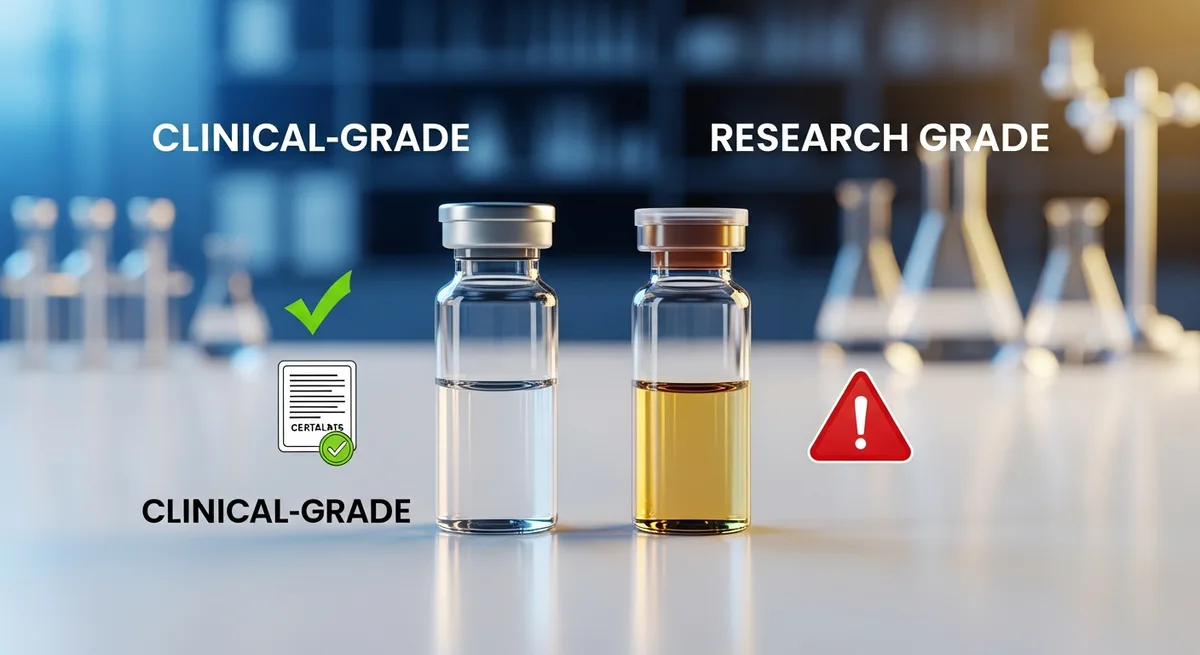
Research-grade peptides fill a regulatory gap. They are sold as laboratory chemicals, not certified for human use, with no guarantee of purity, potency or sterility. Clinical-grade peptides prescribed by a licensed physician are held to pharmaceutical standards at every step: verified sourcing, Certificate of Analysis on every batch, cold-chain logistics and ongoing medical supervision. At PeptidesThailand.com, clinical-grade is the only grade we use.
Read our full guide to clinical-grade vs research-grade peptides →
Research-Grade Peptides in Thailand: The Grey Area Explained
This is the section most online guides either skip entirely or handle vaguely. The reality is straightforward once you understand how the system works.
What Research Grade Actually Means
When a peptide is labelled “research grade” or “for research purposes only,” it means exactly what it says: the product is manufactured and sold for use in laboratory experiments. It is not certified for human administration. It has not passed the quality controls required for pharmaceutical or clinical use.
Most suppliers selling peptides online in Thailand use this labelling to operate in a regulatory gap. Peptides are not narcotics or scheduled drugs, but they are not approved for human use without a doctor’s prescription. Administering research-grade peptides to yourself without a prescription is not legally protected by any Thai regulation.
Are Research-Grade Peptides a Controlled Substance in Thailand?
Most peptides are not scheduled drugs in Thailand. They do not appear on the narcotics list and they are not classified alongside controlled substances. This is an important distinction that many people confuse.
However, not being a controlled substance is not the same as being approved for human use. A product can be perfectly legal to sell as a research chemical while still having no legal standing as a human therapeutic. The fact that you can buy it does not mean you are legally protected when you inject it.
This is the gap that research-grade peptide sellers occupy, and it is the gap that leaves buyers without recourse if quality is poor, purity is compromised or side effects occur.
The Customs Risk
Importing research-grade peptides from overseas into Thailand carries a specific customs risk. Thai customs officers can seize unidentified biological compounds at the border. Packages containing injectable peptides have been stopped, especially when shipped without clear pharmaceutical labelling or documentation.
Domestic supply from within Thailand carries a different risk profile because there is no customs barrier. But the product quality remains unverified and the human-use gap still applies.
International shipping also introduces cold-chain concerns. Peptides that require refrigeration can degrade during transit, particularly during the hotter months in Thailand when ambient temperatures regularly exceed 35°C.
What Happens If Something Goes Wrong
This is the practical legal exposure that most people do not consider when ordering research-grade peptides.
If a research-grade product is mislabelled, contaminated or impure, you have no legal recourse against the supplier. The product was never sold for your intended use. If an adverse reaction occurs, whether an infection from a non-sterile product or a dose-related complication from an inaccurately filled vial, there is no medical liability framework to fall back on. You were using a research chemical outside its intended purpose.
With doctor-prescribed peptides, the situation is entirely different. The doctor holds professional liability. The peptide is prescribed under a valid medical framework. There is accountability, documentation and a clear chain of responsibility.
Doctor-Prescribed Peptides in Thailand: The Fully Legal Route
The legal route for peptide therapy in Thailand is clear and well-established. A doctor licensed by the Medical Council of Thailand assesses the patient, determines clinical appropriateness and issues a prescription. Clinical-grade peptides are sourced through pharmaceutical channels with full Certificate of Analysis documentation, proper cold-chain storage and verified purity.
The patient holds a valid prescription. The supply chain is domestic and pharmaceutical. There is no customs risk, no regulatory grey area and no ambiguity about the legality of the therapy.
This is exactly how PeptidesThailand.com operates. Our medical team, including physicians licensed by the Medical Council of Thailand, designs every protocol individually. Every peptide is clinical-grade. Every patient has full prescription documentation.
What Peptides Can Be Prescribed in Thailand?
A wide range of peptides can be prescribed by a licensed Thai doctor for therapeutic purposes. The key requirement is the doctor-patient relationship and clinical justification. The doctor assesses the patient, determines that a particular peptide is appropriate for their health goals and writes the prescription accordingly.
The full range of peptides that PeptidesThailand.com offers is available through this route. Browse the complete peptide library to see what is available, or ask during your consultation.
Is Telemedicine and Online Prescription Legal in Thailand?
Yes. Telemedicine is legal in Thailand. An online consultation with a licensed Thai doctor, followed by a valid prescription and clinical-grade delivery, is fully compliant with Thai medical law.
This means you do not need to visit a clinic in person to access doctor-prescribed peptides. The consultation happens remotely via video call or email, and your peptides are delivered to your door anywhere in Thailand.
For full details on how the online consultation process works, read our guide to online peptide consultations in Thailand.
What Customs Actually Does with Peptides
Understanding customs is important for anyone who has previously imported peptides or is considering doing so.
International imports. When research-grade peptides are shipped into Thailand from overseas, they pass through Thai customs. Officers have the authority to inspect packages, and injectable biological compounds without pharmaceutical documentation can be flagged, delayed or seized. This is not a theoretical risk. It happens regularly. The sender’s labelling (often vague or misleading) does not provide legal protection.
Domestic purchases. Peptides purchased within Thailand from domestic suppliers do not pass through customs. However, the human-use grey area still applies to research-grade products. The quality and purity remain unverified by any regulatory body.
Travelling with peptides within Thailand. If you hold a valid doctor’s prescription, travelling within Thailand with your prescribed peptides is straightforward. You have documentation that clearly establishes the legality of possession. Without prescription documentation, you have no legal protection if questioned, though in practice, most peptides are not actively policed at domestic checkpoints.
Leaving Thailand with peptides. If you are travelling internationally with peptides, a valid Thai prescription is essential. Different countries have different regulations, and a prescription from a licensed doctor provides the clearest legal standing at any border.
The Bottom Line: How to Stay Fully Legal
There are three options for accessing peptides in Thailand, ordered from most to least legally sound.
Option 1: Doctor-prescribed clinical-grade peptides. Fully legal. Fully protected. Best quality. A licensed Thai doctor prescribes clinical-grade peptides with full documentation, pharmaceutical sourcing and ongoing medical supervision. This is what PeptidesThailand.com provides. Book a consultation to get started.
Option 2: Domestic research-grade suppliers. A legal grey area. The product is not certified for human use. Quality, purity and dosing accuracy are unverified. There is no medical oversight and no legal protection if something goes wrong.
Option 3: International imports. The same grey area as option two, plus customs risk, cold-chain degradation during shipping and longer wait times. The least favourable option from both a legal and a quality standpoint.
The facts speak for themselves. If you want to use peptides in Thailand legally, safely and with confidence in what you are putting into your body, the doctor-prescribed route is not just the best option. It is the only one that removes all legal and quality uncertainty.
Research-Grade Peptides Carry Real Risk
When peptides are manufactured for research purposes, pharmaceutical-grade quality controls do not apply. Purity may be lower than stated, dosing can be inconsistent between batches and sterility is not guaranteed at the level required for human injection. Doctor-prescribed clinical-grade peptides eliminate these variables entirely: verified purity, accurate dosing, proper storage and full medical supervision throughout your protocol. PeptidesThailand.com provides only clinical-grade, doctor-supervised peptide therapy.
Read our full guide to clinical-grade vs research-grade peptides →
Frequently Asked Questions on Peptide Legality
For more answers to common questions about peptide therapy, visit our comprehensive FAQ page.
Are peptides illegal in Thailand?
Peptides require a doctor’s prescription to be used legally in Thailand. Research-grade peptides sold as “not for human use” are not approved for human administration. The only fully legal route is doctor-prescribed clinical-grade peptides obtained through a licensed Thai physician.
Can I bring peptides into Thailand from overseas?
Research-grade peptides imported from overseas carry customs risk and no legal protection. Doctor-prescribed peptides sourced domestically through a licensed Thai doctor carry no such risk.
Can I travel within Thailand with peptides?
With a valid doctor’s prescription, travelling within Thailand with prescribed peptides is straightforward. Without prescription documentation you have no legal protection if questioned.
What is the penalty for illegal peptide possession in Thailand?
Most peptides are not scheduled substances and specific possession penalties do not apply in the same way as with narcotics. However, operating without proper prescription documentation leaves you legally exposed in ways that are entirely avoidable.
Is it legal to buy peptides online in Thailand?
Using peptides without a doctor’s prescription is not legal for human administration in Thailand. Research-grade products are not certified for human use and offer no legal protection. The only fully legal route is through a licensed Thai doctor who writes a valid prescription. Book a consultation to get started legally.
Get Legal, Doctor-Prescribed Peptides Anywhere in Thailand
Skip the uncertainty of research-grade suppliers. Our licensed doctors design your personalised peptide protocol, source pharmaceutical-grade peptides and support you every step of the way, whether you are in Bangkok, Phuket, Pattaya, Chiang Mai or anywhere else in Thailand.
Doctor-prescribed · Clinical-grade · Nationwide delivery